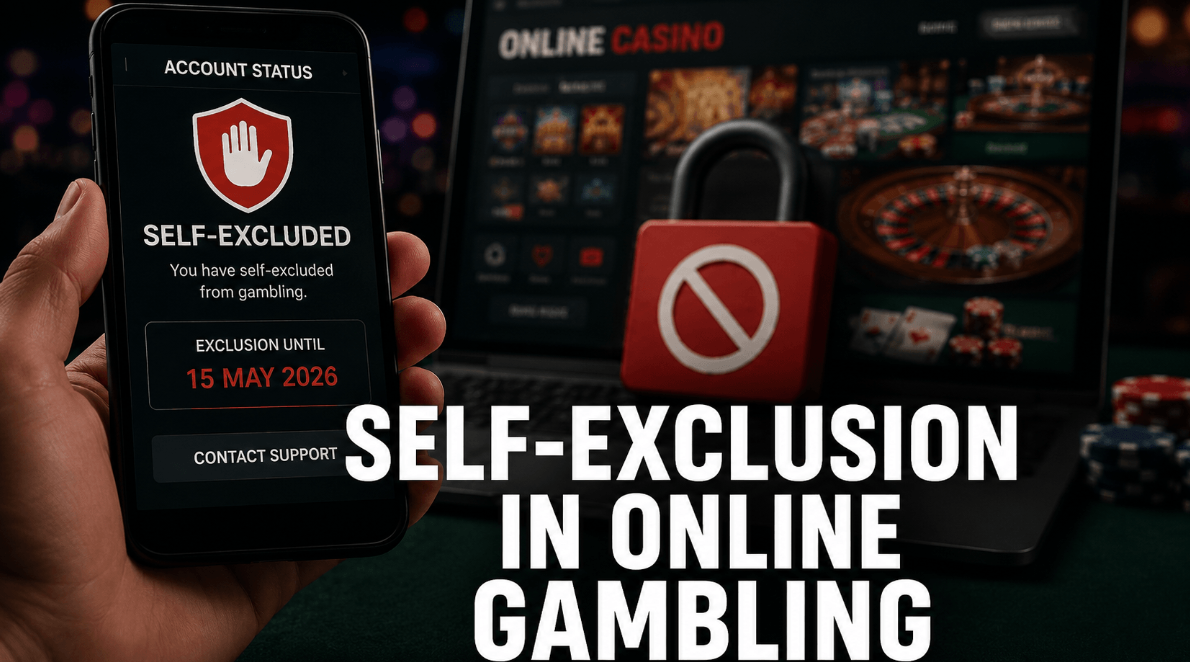
Self-exclusion is one of the most direct, consequential tools in responsible gambling. It's not a soft nudge or a reminder. It's a binding request — one that instructs an operator to block your access, freeze your account, and stop all marketing communications for a defined period. Understanding how it works before you need it is always better than scrambling during a crisis.
This guide covers how self-exclusion operates, what types of programs exist, and how to apply it across different platforms and jurisdictions.
What Is Self-Exclusion in Gambling?
Self-exclusion is a formal, player-initiated request to be barred from a gambling platform — or a network of platforms — for a specified period. Once activated, the operator is legally obligated to enforce it. The player loses access to their account, ceases to receive promotions, and cannot circumvent the restriction by creating a new account on the same platform.
Self-exclusion differs from a simple account pause or a deposit limit. Those tools restrict behaviour while keeping the account accessible. Self-exclusion, by contrast, removes access entirely. Most regulatory frameworks treat it as the highest-level player protection tool available.
Why Self-Exclusion Exists: The Regulatory and Player Protection Context
How Responsible Gambling Frameworks Require Self-Exclusion Tools
Regulators don't treat responsible gambling as optional. Licensing bodies across Europe and beyond require operators to integrate self-exclusion systems as a condition of their licence. The underlying logic: gambling products carry inherent harm potential, and licensed operators have an obligation to mitigate it.
Responsible gambling frameworks — the broader set of tools that includes deposit limits, reality checks, time-outs, and cooling-off periods — treat self-exclusion as the most restrictive tier. Players who have exhausted softer tools, or who recognise a developing problem, are directed toward it specifically.
Which Regulators Mandate Self-Exclusion for Licensed Operators
The UK Gambling Commission (UKGC) mandates self-exclusion for all UK-licensed operators and requires participation in national multi-operator schemes. The Malta Gaming Authority (MGA) similarly obliges MGA-licensed operators to offer self-exclusion, both at the individual operator level and through the national GAMSTOP-equivalent scheme. Other notable authorities include the Danish Gambling Authority (Spillemyndigheden), which runs the ROFUS program, and Germany's GGL (Gemeinsame Glücksspielbehörde der Länder), which administers the OASIS database.
Operators who fail to enforce self-exclusion face licence suspension, substantial fines, or both.
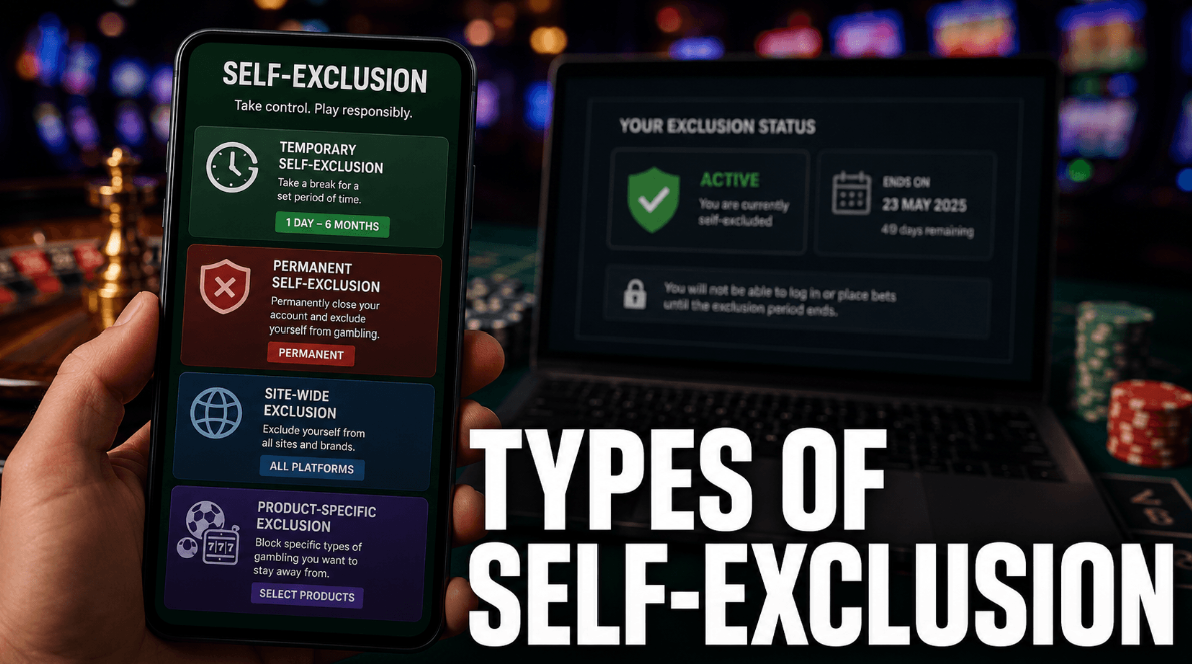
Types of Self-Exclusion
Single-Operator Self-Exclusion
The most basic form. A player requests exclusion directly from one specific platform — casino, sportsbook, or both. The operator applies the block, and the player's account is suspended for the chosen duration. This type doesn't affect accounts held at other operators.
Multi-Operator Self-Exclusion Schemes
Some regulatory frameworks extend self-exclusion across a network of operators sharing a common database. When a player registers with a multi-operator scheme, every participating operator receives a flag and must block that player on their own platform as well. The player doesn't need to contact each operator individually.
National Self-Exclusion Programs
Several countries have built national-level programs that cover all licensed operators within their jurisdiction. GamStop in the UK, ROFUS in Denmark, and OASIS in Germany are the best-established examples. These programs create a centralised registry. Operators check incoming registrations against it and block any player on the exclusion list.
Voluntary vs. Regulatory-Mandated Exclusion
Voluntary exclusion is player-initiated — the player chooses when to activate it and for how long. Regulatory-mandated exclusion is less common and typically occurs when an operator or regulator identifies a player as displaying problem gambling behaviour. In the latter case, the exclusion may be applied without the player's request and may have different reinstatement rules.
How Self-Exclusion Works on Licensed Platforms
How to Activate Self-Exclusion on an Online Casino or Sportsbook
The activation process is standardised across most regulated platforms. Here's the typical step-by-step:
- Log into your account on the operator's website or mobile app.
- Navigate to Responsible Gambling (sometimes listed under Account Settings, Player Protection, or Safety Tools).
- Select Self-Exclusion from the list of available tools.
- Choose a duration — options typically range from 6 months to permanent exclusion.
- Confirm your identity if required (some platforms ask for date of birth or account password as a confirmation step).
- Submit the request. The exclusion takes effect within 24 hours on most platforms, though many apply it immediately.
- Check for a confirmation email — this is your record that the exclusion has been processed.
If you can't find the self-exclusion tool within your account, contact the operator's customer support directly and request it in writing. Licensed operators are legally required to provide it.
What Happens to the Account After Exclusion Is Applied
Once exclusion is active, the account is suspended — not deleted. You won't be able to log in, place bets, or access any gambling features. The operator will also suppress all marketing communications tied to that account: promotional emails, SMS offers, push notifications, and targeted advertising.
Your account history, transaction records, and any pending withdrawals remain intact. The suspension does not erase prior data.
How Pending Withdrawals and Balances Are Handled
This is a question we see frequently. The standard procedure across regulated platforms: any funds already in the player's account — including pending withdrawal amounts — remain accessible and will be returned. The operator processes outstanding withdrawal requests even after exclusion is applied.
If a balance exists in the account and no withdrawal has been initiated, the operator will typically contact the player directly (using the account's registered contact details) to arrange the return of funds. The money is not forfeited.
Licensed platforms offering xbet download and other gaming options follow similar standards, ensuring that account funds remain separate from exclusion restrictions and can be withdrawn upon request.
Self-Exclusion Duration Options
Short-Term Exclusion: 24 Hours to 6 Months
Some platforms offer very short-term exclusions — 24 to 72 hours — though these are more accurately classified as cool-off periods. True self-exclusion more typically starts at 6 months under most regulatory frameworks. Short-term options are useful for players who recognise a temporary trigger (stress, a specific event) and want to create a structured gap.
Mind you, short-term exclusions are the most likely to be reversed prematurely. They require the same reinstatement process as longer exclusions, but the window for reconsidering is shorter.
Long-Term Exclusion: 1 Year to 5 Years
The most commonly chosen range for players actively working on problem gambling. Durations of 1, 2, 3, or 5 years give enough distance to establish new habits and seek support from organisations like GamCare, BeGambleAware, or Gamblers Anonymous before returning to any gambling activity.
Most regulators require a mandatory review period before reinstatement — typically 7 days minimum — during which the player must reconfirm their intention to return.
Permanent Self-Exclusion: How It Works and Whether It Can Be Reversed
Permanent exclusion is exactly what it sounds like. The account is closed without an end date. The player's details are retained on the operator's and any relevant national exclusion database permanently.
Can it be reversed? Technically, yes — but only after a significant waiting period (commonly 5 to 7 years depending on jurisdiction) and a formal review process with the operator or national scheme administrator. The process is deliberately difficult. Some national schemes, such as GamStop, allow removal requests only after a minimum of 5 years and require a 7-day cooling-off period before any removal takes effect.
National Self-Exclusion Programs by Country
GamStop (United Kingdom)
GamStop is the UK's national multi-operator self-exclusion scheme, administered under UKGC rules. All UK-licensed operators are required to participate. A single registration at GamStop.co.uk applies the exclusion across every participating operator. Duration options: 6 months, 1 year, or 5 years. Permanent removal requests are processed after a minimum of 5 years.
ROFUS (Denmark)
ROFUS (Register Over Frivilligt Udelukkede Spillere) is Denmark's national voluntary exclusion register. Operated by the Spillemyndigheden (Danish Gambling Authority), ROFUS covers all Danish-licensed operators. Players register at rofus.nu. Exclusion options range from temporary (as short as 24 hours) to permanent. The program also blocks access to unlicensed gambling sites via ISP-level filtering in some cases.
OASIS (Germany)
OASIS (Overarching Approach to Safer Gambling) is Germany's national database, operated by GGL. All operators licensed under Germany's Interstate Treaty on Gambling (Glücksspielneuregulierungsstaatsvertrag) are required to integrate with OASIS in real time. Exclusions are applied across all participating operators simultaneously. Reinstatement requires an in-person verification process in many cases.
How These Programs Share Data Across Operators
All three programs use a centralised API-based verification model. When a player registers at an operator, that operator queries the national database before completing account setup. If the player's details match an active exclusion record, registration is blocked automatically. Existing account holders who register for national exclusion have their accounts flagged and suspended across all participating operators within the system's synchronisation window — typically within hours.
What Self-Exclusion Covers and What It Does Not
Self-exclusion is powerful — but it has defined limits. Here's what it typically covers, and where it doesn't reach:
What self-exclusion covers:
- Full suspension of the player's online account(s) at the operator or network of operators
- All marketing communications: email, SMS, push notifications, retargeted ads
- Access to gambling features across the operator's entire product (casino, sports betting, live dealer, lotto, and virtual sports)
- Registration of new accounts at the same operator (operators check new registrations against exclusion databases)
What self-exclusion typically does not cover:
- Accounts held at operators outside the exclusion network (single-operator exclusion only affects that operator)
- Land-based gambling venues, unless the player separately registers with a land-based exclusion scheme
- Affiliate or review websites — these don't host gambling themselves, so exclusion doesn't block access to them
- Unlicensed (offshore) operators — these fall outside regulatory jurisdiction
- Credit cards or payment accounts used for gambling — banking-level blocks require separate action with the financial provider (such as Gamban for device-level blocking, or GamBan for bank-side restrictions)
How Operators Are Required to Enforce Self-Exclusion
Licensed operators have specific technical and procedural obligations once a self-exclusion is active. They must:
- Immediately suspend account access so login is no longer possible
- Remove the player from all marketing and CRM databases
- Reject any re-registration attempt from an excluded player (name, date of birth, and address matching is standard)
- Refund any remaining account balance to the player
- Report compliance with national scheme requirements to their licensing authority on a regular basis
Operators who allow an excluded player to continue gambling — even if the player circumvents the system using different details — face regulatory enforcement. The UKGC, in particular, has issued multi-million pound fines for self-exclusion enforcement failures.
Self-Exclusion vs. Deposit Limits vs. Cool-Off Period: Comparison Table
|
Tool |
Duration |
Account Access |
Marketing Blocked |
Reversible |
Regulatory Requirement |
|
Deposit Limit |
Ongoing / player-set |
Full access maintained |
No |
Yes, within 24–72 hrs |
Required by UKGC, MGA |
|
Cool-Off Period |
24 hrs – 6 weeks |
Restricted (no gambling) |
Usually yes |
Yes, after period ends |
Varies by jurisdiction |
|
Self-Exclusion (short) |
6 months – 1 year |
Suspended |
Yes |
After period ends, with review |
Required by most major regulators |
|
Self-Exclusion (long) |
1 year – 5 years |
Suspended |
Yes |
After period ends, mandatory review |
Required by most major regulators |
|
Permanent Self-Exclusion |
No end date |
Permanently closed |
Yes |
Only after 5+ years, formal process |
Required by most major regulators |
|
Account Closure |
Indefinite |
Closed |
Yes |
Varies — may require new registration |
Operator policy |
National Self-Exclusion Programs Comparison Table
|
Program |
Country |
Operator Coverage |
Duration Options |
Data Sharing Mechanism |
How to Register |
|
GamStop |
United Kingdom |
All UKGC-licensed operators |
6 months, 1 year, 5 years |
Centralised API, real-time |
GamStop.co.uk |
|
ROFUS |
Denmark |
All Spillemyndigheden-licensed operators |
24 hrs to permanent |
Centralised database, real-time |
ROFUS.nu |
|
OASIS |
Germany |
All GGL-licensed operators |
Variable; permanent available |
Centralised API, mandatory integration |
Via operator or GGL portal |
|
GAMBAN |
Multi-country (device level) |
N/A — device-level software |
Subscription-based |
No database — local device blocking |
GAMBAN.com |
|
Spelpaus |
Sweden |
All Spelinspektionen-licensed operators |
1 month, 3 months, 1 year, permanent |
Centralised API, real-time |
Spelpaus.se |
How to Reinstate an Account After a Self-Exclusion Period Ends
When a self-exclusion period expires, the account doesn't automatically reopen. Reinstatement is always a deliberate, separate action. The standard process:
- Wait for the exclusion period to end. The account remains closed until the player actively requests reinstatement — it doesn't reopen automatically.
- Contact the operator or national scheme (for national programs like GamStop, this means submitting a reinstatement request to the scheme directly, not the individual operator).
- Complete the mandatory cooling-off period. GamStop, for example, enforces a minimum 7-day gap between a reinstatement request and access being restored.
- Verify identity. Most operators and schemes require identity confirmation before reinstating.
- Reconsider. Many schemes recommend speaking with a responsible gambling support organisation — GamCare, Gamblers Anonymous, or BeGambleAware — before reinstating, particularly after long-term exclusions.
The gap between request and reinstatement is intentional. It's designed to prevent impulsive decisions.
What to Do If a Self-Excluded Account Is Still Accessible
This does happen — usually due to a technical error, a database synchronisation delay, or an operator failing to enforce the exclusion correctly. If you find that a self-excluded account remains accessible:
- Do not use the account. Any gambling activity while technically excluded may complicate both your exclusion record and any future complaint.
- Contact the operator immediately in writing — email is preferable, as it creates a record. State clearly that you are registered for self-exclusion and that your account remains accessible. Request immediate suspension.
- File a complaint with the relevant regulator if the operator fails to act. For UK players, that's the UKGC; for MGA-licensed operators, complaints go to the MGA. Regulators take enforcement failures seriously.
- If you're using a national scheme (GamStop, ROFUS, OASIS), contact the scheme directly as well — they can flag the specific operator for review.
Support organisations can also help you navigate this. GamCare (gamcare.org.uk) and the National Gambling Helpline (0808 8020 133 in the UK) are available 24/7.
FAQ
How quickly does self-exclusion take effect after I request it? Most regulated operators apply the exclusion within 24 hours of the request, and many do so immediately. National scheme registrations (GamStop, ROFUS) propagate to all participating operators within the scheme's synchronisation window, typically the same day.
Can I self-exclude from one game type but not others on the same platform? No. Self-exclusion applies across the operator's entire platform. You cannot exclude from slots while keeping access to sports betting on the same account. For product-specific restrictions, deposit limits or cool-off periods are more appropriate tools.
Will self-exclusion affect my ability to register at a new casino? For single-operator exclusion: no, only that operator is affected. For national scheme exclusions (GamStop, ROFUS, OASIS): yes — all participating operators will reject new registrations from excluded players.
What happens to my account balance when I self-exclude? Your balance is preserved. The operator is required to return any remaining funds to you. Most platforms do this automatically via the withdrawal method you've previously used; others will contact you directly to arrange the transfer.
Can self-exclusion be broken or bypassed? Technically, a player could attempt to register at a different operator with altered details. Regulated operators are required to use identity verification to detect this. Attempting to circumvent a self-exclusion is strongly discouraged — it removes the protection you've put in place for your own benefit.
Does self-exclusion cover in-app gambling features and mobile apps? Yes. The exclusion applies to the operator's entire product, regardless of whether it's accessed via desktop, mobile browser, or native app.
Where can I find support alongside self-exclusion? Several organisations provide free, confidential support for problem gambling:
- GamCare — gamcare.org.uk
- BeGambleAware — begambleaware.org
- Gamblers Anonymous — gamblersanonymous.org.uk
- National Gambling Helpline (UK) — 0808 8020 133
Self-exclusion addresses account access. These organisations address the underlying issues.
Gambling should be approached as entertainment, not as a source of income. If gambling is no longer enjoyable or is causing financial, emotional, or relationship difficulties, self-exclusion and professional support are available. 18+ only. Always check the laws applicable in your country before gambling online.